1. Project
For this project, we have chosen the Big Garden Birdwatch, and hope to build upon it to design a paper-based birdwatching activity for children and families at Burgess Park.
The basic methodology of the original project is as follows:
Observe for one hour at a single location → Identify the birds → Record the maximum number of each species present at any one time
We wish to retain this observation method whilst incorporating hand-drawn identification cards, stickers and a map, so that children and parents can take part together.
2. Field Research
Location: Burgess Park
Time: Sunday afternoon, approximately one hour
Weather: Fairly windy
This research focused primarily on three questions:
What birds are there? → Where are they and what are they doing? → What are the people around them doing?
I have organised the research into two sections:
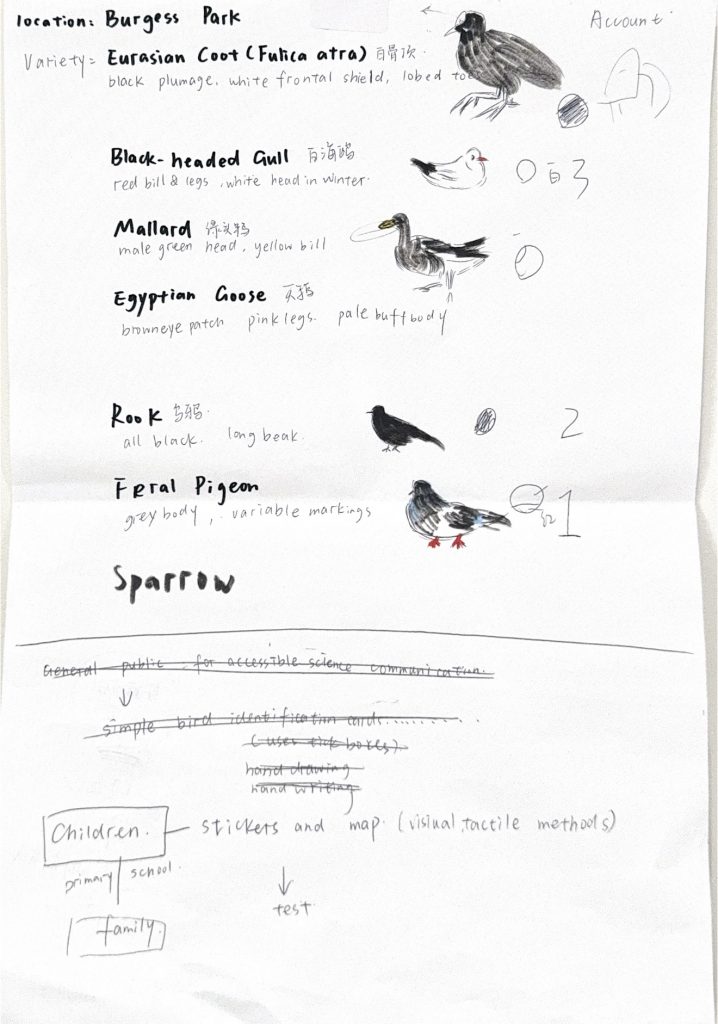
① Bird Identification Pages
I documented birds such as the Great Egret, Common Gull, Mallard, Egyptian Goose, Hooded Crow and Feral Pigeon, using hand-drawn illustrations and brief text to highlight their physical characteristics. For example, the Great Egret’s white forehead patch, the male Mallard’s green head, and the brown patches around the Egyptian Goose’s eyes.
Compiling physical characteristics → Pairing them with hand-drawn illustrations → Using them as source material for future identification cards
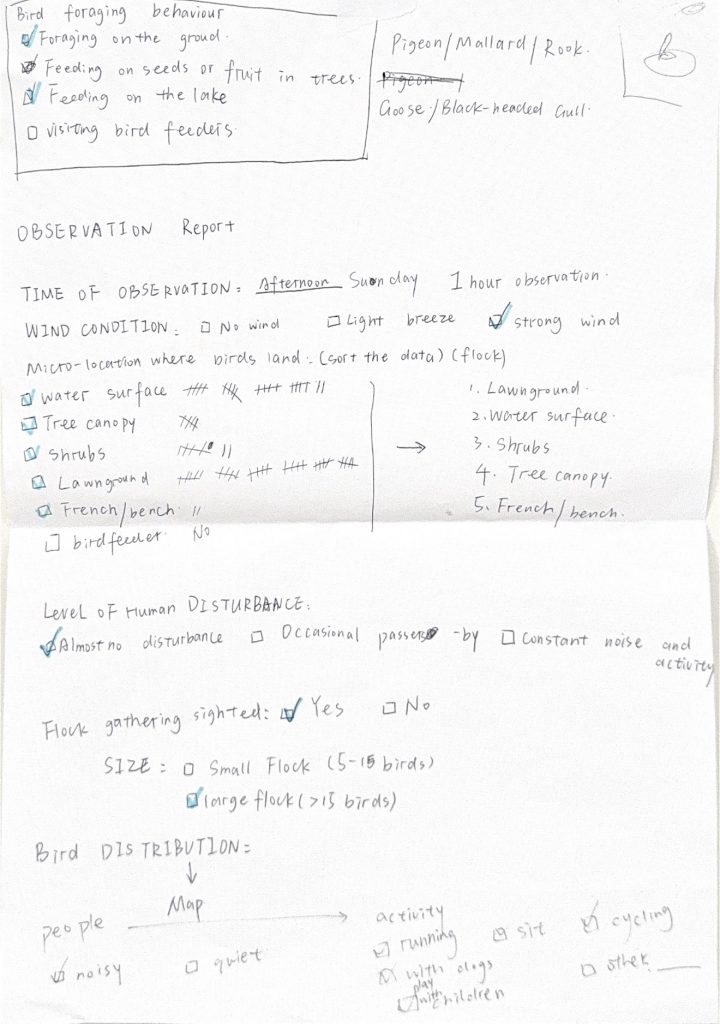
② Field Observation Form
I recorded the time, wind strength, birds’ foraging behaviour, resting locations, degree of human disturbance, and the extent of flock aggregation.
Listed in descending order:
Lawn → Water surface → Shrubs → Tree canopy → Fence/bench
I also recorded activities such as jogging, cycling, walking the dog, sitting and resting, and playing with children. I intend to plot this data on a map later to examine the relationship between areas of human activity and the locations where birds congregate. The data collected this time is not yet sufficient to determine whether human activity has affected the birds.
Idea: Bird distribution → Map ← People and activities
3. From Research to Design
Simple bird identification cards → Aimed at children and families → Observation activities combining stickers and maps
I would like children and parents to first search for and identify birds using hand-drawn illustrations, then place the corresponding stickers at the observation points on the map.
Look at the identification guide → Search for birds → Observe their location and behaviour → Record findings on the map
In this way, participants will not only pay attention to the birds’ appearance but also note whether they are swimming on the lake, foraging on the lawn, or perched in a tree. This idea still needs to be tested in practice to see if the images and steps are easy to understand.
4. Areas where the recording method needs adjustment
How to record numbers is an issue that needs to be clarified next. ‘Big Garden Birdwatch’ records the maximum number of birds of each species present at any one time; individual sightings should not be added together.
For example:
First, three pigeons are spotted → Later, five are seen at the same time → Then, two more are spotted → The final record is five
My current tick-based recording system also needs to specify the unit of count. In the next version, the two types of recording could be separated:
Sticker map → Record where the birds were seen
Counts table → to record the maximum number of birds of each species present at any one time
5. Next steps
Create a paper prototype → ask others to try it out → note down any issues → revise and test again
I want to focus on whether others can make sense of the hand-drawn identification diagrams, locate positions on the map, and understand the rules for recording numbers.
The strong winds that day also reminded me that how the paper is secured, whether the stickers are easy to remove, and whether it is convenient to observe and record at the same time all need to be tested outdoors before any adjustments are made.
Leave a Reply